_(14566397697).jpg/440px-Wonder_tales_from_Scottish_myth_and_legend_(1917)_(14566397697).jpg)
Painted by John Duncan (1917)
The Cailleach is a pre-Celtic Gaelic goddess credited with the formation of Scotland's mountains to make into her stepping stones. She is the personification of the winter, with blue skin, and white hair according to folklorist Donald Mackenzie. The Queen of Winter is not purely good or purely evil, she is simply the cycle of nature.
 Legends and Traditions of the Cailleach Bheara or Old Woman (Hag) of Beare
by
Legends and Traditions of the Cailleach Bheara or Old Woman (Hag) of Beare
by
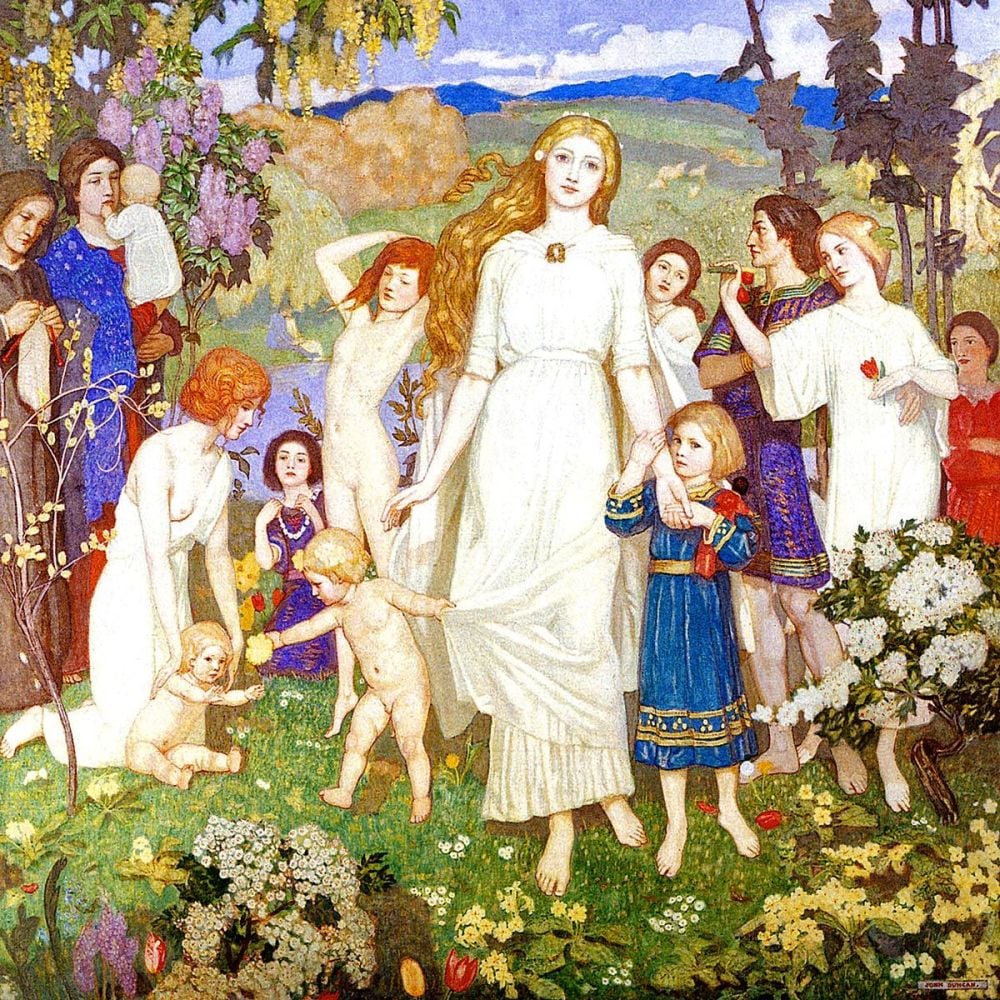
Painting by John Duncan (1917)
This Celtic goddess is considered by some to be a triplet goddess. Her sisters are all share the name Brighid and are goddesses over healing, poetry, and smith-working. In some legened Brighid or Bride, brings in the spring when the Cailleach is no longer able to hold onto winter.
The story of Angus and Bride is one legend explaining how spring comes after winter. It includes an imprisoned goddess named Bride, though in most adaptations she is the goddess Brighid. It is a story of love, dedication, and the unavoidable cycle of life.
Like Greek and roman mythology, some of the stories shared between Celtic and Gaelic countries have same gods with different names. However, there are some that stand alone according to the region.
William Wallace is a real historical figure that has reached legendary status. Like Robert the Bruce, Wallace was a part of Scotland's rebellion against England. Due to the nature of Wallace's time, many accounts of his feats have a supernatural element such as visions in balls of fire, and fighting killed soldiers. All in an effort to scare the English soldiers, and inspire other Scots to join.
The Highlander film made in 1986 with many ties to Scotland. The MacLeod clan, whom the protagonist Connor MacLeod is from, is found in the Socttish Highlands with a branch tied to the Dunvegan castle. The movies tagline "There can only be one" has become a popular saying in media. Although the story is purely fictional it does highlight the creativity Scottish landscapes and lore can inspire.

Illustration by Beatrice Elvery
A legendary Scottish warrior teacher whose most famous student is the Irish hero Cú Chulainn. Her base called the "Fortress of Shadows" is believed to be on the Isle of Skye where she taught the students underwater combat, pole vaulting, and fighting with a barbed harpoon. She has many other titles including goddess, poet, and prophet.
 Women Warriors
by
Women Warriors
by
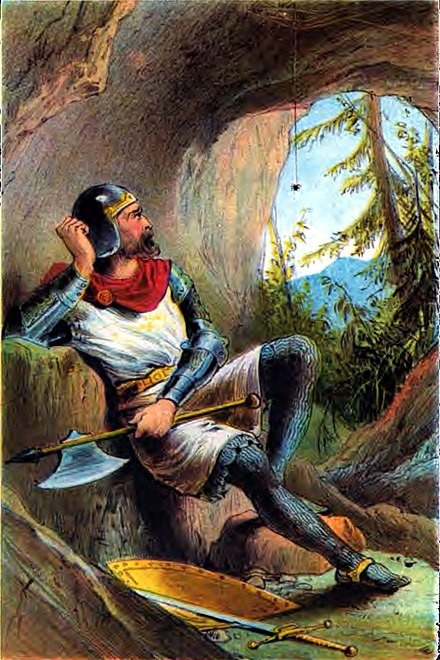
Robert the Bruce watching a spider (Who were the first weavers?, T. Nelson and Sons, 1885)
"If at first, you don't succeed: try, try, try again."
A story of perseverance and an "Outlaw King". Robert the Bruce, a king of Scotland exiled by the English, is hiding in a cave after suffering many major defeats. While hiding he saw a spider fighting to make its web. After each failed attempt, the spider continued to try until it finally attached a single strand. From that strand he was able to build his web. The exiled king took inspiration from the spider's perseverance and continued his fight.
Robert the Bruce
by
